The True Cost of Your Clothes: What Fast Fashion Isn’t Telling You
Welcome to the first in a series exploring how we got here — and what we can do about it.
If you’ve ever grabbed a £5 t-shirt without thinking twice, you’re not alone. Most of us have. But that price tag doesn’t reflect what it actually costs to make that garment — to people, to the planet, or to our future.
This isn’t about guilt. It’s about understanding. Because once we see the bigger picture, we can start making different choices. Together.
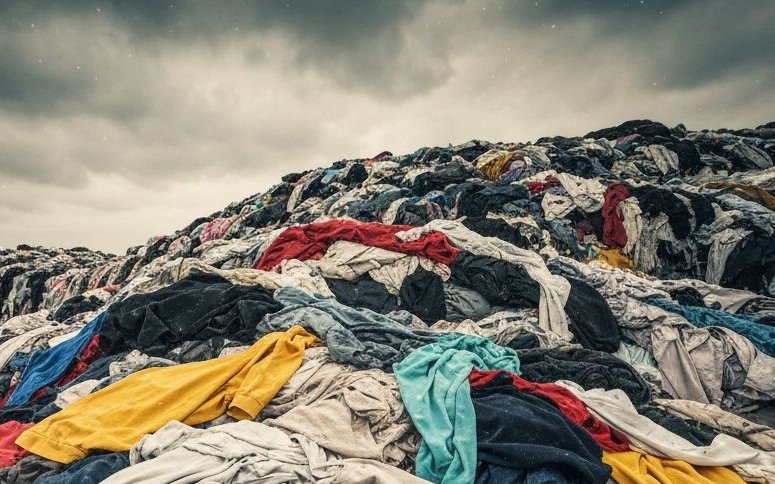
We’re drowning in clothes
The numbers are staggering. Globally, the fashion industry produces around 92 million tonnes of textile waste every year. That’s expected to rise to 134 million tonnes by 2030 if nothing changes.
Here in the UK, we’re not exactly leading by example. We consume more clothes per person than any other country in Europe, throwing away approximately 300,000 tonnes of clothing every year. That works out to around 35 items per person going into general waste annually — making us the fourth-largest textile waste producer in Europe.
UK SNAPSHOT
Nearly half of all used textiles in the UK are simply binned — not recycled, not donated, just thrown away with the household rubbish. About 30% of unwanted clothes end up in landfill.
Source: WRAP Textiles Market Situation Report 2024
The speed of fashion is accelerating
The term “fast fashion” was first coined in the 1990s to describe Zara’s ability to take a design from concept to shop floor in just 15 days. That seemed remarkable at the time.
Today, companies like Shein have taken this to another level entirely. A new design can become a finished garment in as little as 10 days, with up to 10,000 new items added to the site daily. At any given moment, there may be 600,000 items for sale — most priced around £8. Research suggests that 44% of Gen Z in the US buy at least one Shein item every month.
THE SHEIN EFFECT
In 2024, Shein generated 26.2 million tonnes of carbon dioxide emissions — a 23% increase from the previous year. That’s equivalent to the annual output of multiple coal-fired power plants, and it’s still growing.
Sources: Shein Sustainability Report 2024, Yale Climate Connections
The low prices are deliberate. They encourage us to treat clothes as disposable. Buy it, wear it once or twice, throw it away, buy something new.
The environmental cost
Fashion doesn’t just create waste at the end of a garment’s life. The damage starts long before you ever try something on.
Water
The fashion industry is the second-largest consumer of water in the world, using approximately 93 billion cubic metres annually — enough to meet the needs of five million people.
To put that in perspective: producing a single cotton t-shirt requires around 2,700 litres of water. That’s enough drinking water for one person for 900 days. A pair of jeans? Over 7,500 litres.
Much of this water becomes polluted with toxic chemicals from dyeing and finishing processes. The industry produces about 20% of global wastewater, and textile dyeing is the second-largest polluter of clean water globally, after agriculture.
Carbon
The fashion industry is responsible for an estimated 8-10% of global carbon emissions — more than international flights and maritime shipping combined. If the industry continues on its current path, greenhouse gas emissions from textiles are projected to increase by more than 60% by 2030.
Plastic
Here’s something that might surprise you: about 60% of our clothes contain plastic. Polyester, nylon, acrylic — these are all synthetic fibres derived from fossil fuels.
Every time we wash these garments, they shed tiny plastic particles called microfibres. These are so small that they pass through wastewater treatment and end up in our rivers and oceans. A single 6kg wash of polyester clothes can release nearly 500,000 microfibres.
MICROPLASTIC POLLUTION
Around 35% of ocean microplastics come from synthetic textiles — making fashion the single largest source of primary microplastic pollution in our seas. Washing clothes releases an estimated 500,000 tonnes of microfibres into oceans every year. If current trends continue, 22 million tonnes of microfibres will enter our oceans between 2015 and 2050.
Sources: IUCN, Nature Scientific Reports
These microfibres have been found in fish, shellfish, table salt, drinking water — and even human blood.
The human cost
Behind the cheap prices are real people. The global fashion industry employs around 75 million workers, most of them women, many of them earning poverty wages in conditions that would be illegal in the UK.
Rana Plaza: A tragedy that changed nothing (and everything)
On 24 April 2013, an eight-storey building called Rana Plaza collapsed in Bangladesh. The building housed five garment factories making clothes for major Western brands.
The day before, engineers had discovered large cracks in the structure and declared it unsafe. Banks and shops on the lower floors closed immediately. But factory managers on the upper floors ordered workers to return the next morning. Some workers who hesitated were threatened with withheld wages. Others were reportedly beaten.
When the building collapsed, 1,134 people died — mostly young women earning approximately £12 per week. Nearly 2,600 were injured, many requiring amputations. It remains the deadliest garment factory disaster in history. At least 29 global brands were later identified as sourcing from factories in the building.
THE AFTERMATH
The disaster led to significant reforms in Bangladesh, including the Accord on Fire and Building Safety. But over 63% of survivors never worked in a garment factory again — and the fundamental problem remains: pressure to produce clothes as cheaply and quickly as possible is still embedded in the industry’s business model.
Sources: ILO, Clean Clothes Campaign, ActionAid
Forced labour in cotton production
An estimated 23% of the world’s cotton comes from the Xinjiang region of China. Human rights organisations have documented systematic forced labour affecting the Uyghur population in this region.
The US State Department has described the situation as genocide. The Chinese government has detained and “re-educated” more than one million Uyghurs, with many thousands forced to work in cotton production and textile manufacturing. Between 2017 and 2019, more than 80,000 Uyghurs were transferred out of Xinjiang to work in factories across China.
THE XINJIANG COTTON CRISIS
1 in 5 cotton garments globally may be at risk of links to forced labour. The complexity of global supply chains means that even well-intentioned brands often cannot guarantee their products are free from exploitation. To date, 83 major brands have been implicated in supply chain investigations.
Sources: Coalition to End Forced Labour in the Uyghur Region, Sheffield Hallam University, Australian Strategic Policy Institute
What does this mean for us?
Reading all of this can feel overwhelming. The problems are global, systemic, and deeply embedded in how our economy works.
But here’s what I believe: awareness is the first step.
We didn’t create this system, but we are all part of it. And that means we have power — as consumers, as citizens, as communities — to push for something better.
In upcoming posts, I’ll be sharing practical things we can all do: how to make clothes last longer, simple repairs anyone can learn, how to shop more thoughtfully, and why choosing quality over quantity isn’t just about ethics — it often saves money too.
For now, I’ll leave you with this thought: that £5 t-shirt was never really £5. Somewhere, someone or something paid the difference.
Sources and further reading
- WRAP Textiles Market Situation Report 2024
- ILO: The Rana Plaza Disaster Ten Years On
- Coalition to End Forced Labour in the Uyghur Region
- IUCN: Primary Microplastics in the Oceans
- Fashion Revolution
This is the first post in a series about fashion, sustainability, and what we can do differently. Next time: The Joy of Keeping Clothes Alive — why mending isn’t just practical, it’s radical.